Breastfeeding and postpartum: How to get the best start
We hope the following text can help you get the best possible start at breastfeeding and the first weeks with your new baby.

Denne teksten er oversatt fra norsk til engelsk av Rachel Myr.
The first six weeks after birth are called the puerperium. It‘s an especially vulnerable time for mothers, their partners, and babies.
The content on this page is based on our experience helping new parents with their questions about breastfeeding, breast milk, and everything associated with them.
You will find more in-depth explanations and sources of further knowledge in English and other languages under each theme throughout the text.
This text is based on two articles from ammehjelpen.no, one about how to start breastfeeding, and one about postpartum, both in Norwegian.
Other useful websites:
- Infant food and breastfeeding
- Pregnancy, birth and postpartum in Norway (information in English from the Norwegian health authorities)
- Safe medication use while pregnant or breastfeeding (only in Norwegian)
International resources
- Global Health Media: Videos about breastfeeding and other relevant topics for both new parents and health professionals in several languages.
- Unicef / Baby Friendly Initiative (several languages)
- Unicef / Baby Friendly Initiative (english)
- Breastfeeding Support (english)
- KellyMom (english)
- La Leche League (several languages)
- BASIS: Normal infant sleep (english)
- Ready to relate (english)
- Early Beginnings (english/danish)
About Ammehjelpen
Ammehjelpen is a voluntary organization. Since 1968 we have been there for our peers with breastfeeding support, information and guidance, free of charge.
We know that breastfeeding can be fantastic, practical and relaxing. We also know that breastfeeding can be demanding, exhausting and frustrating – especially in the beginning.
And we know that it often helps to talk to someone who has been through the same thing.
We’re here to help you whether you breastfeed just a little, or breastfeed a lot, or if you want to stop breastfeeding.
Ammehjelpen.no is Norway’s most extensive source of updated knowledge about breastfeeding and breast milk.
We also write about bottle feeding, sleep, and normal infant behavior.
The content on our website is founded on evidence-based practice. This means that we use knowledge from research and theory, combined with our own practical experience, and that of others. Our guidance is tailored to the individual situation.
We follow guidelines and recommendations for breastfeeding and related topics, from Norwegian and international health authorites.
Five essential points for a good start at breastfeeding
- Breastfeeding is a joint effort
- Skin-to-skin contact
- Good positioning for you and baby
- Frequent feeds
- Knowledge about normal newborn behavior
Pts. 1-4: borrowed from The Danish Resource Center for Breastfeeding
Pt. 5: Breastfeeding Series, The Lancet, 2023
The following text contains general knowledge about breastfeeding and breast milk. It is not a substitute for a consultation with a health care professional. Contact your midwife, health visitor, doctor, or an acute care facility (legevakt) if you have medical questions.
Breastfeeding is a joint effort
What we write about is for the most part aimed at you who have given birth to the baby. This doesn’t mean we feel the information is unimportant for partners – on the contrary!
The more your partner or support person knows about breastfeeding and breast milk, the more support and understanding they can give you for breastfeeding – and the better your chances of breastfeeding working well for you.
You who are a partner or other support person may not be able to breastfeed, but there is plenty you can do – for example, learn about…
- What’s normal to experience in the first weeks after birth
- How breastfeeding and milk supply work
- What minor and major challenges may arise
- Who you can contact for help
- How you can give the best support, whether breastfeeding works out or not
You can learn more about all this in the following text.
Pregnant, or a new mother?
You’ll probably be surprised at how much time you spend breastfeeding, or getting milk into the baby in other ways – especially in the first days and weeks – and how much it affects you.
The learning curve can be steep. You may feel your breasts are out all the time because you’re feeding constantly. But it won’t be so intense throughout your entire time breastfeeding; it gets easier. Breastfeeding does best when you trust yourself, your baby and your breasts – if you follow your gut feelings and listen to your instincts.
Breastfeeding is natural, but it isn’t always simple.
It can take a little time to get the hang of it, and good support is vital in the early days. We think it’s important you know that when you get into the rhythm of it, it can suddenly be simple, practical, and nice.
If you experience small or large bumps in the road on your way, remember: you’re not alone. There is help available.
Don’t hesitate to ask for help from the staff in the hospital and at your child health centre who are trained to give good breastfeeding guidance. And seek support from us in Ammehjelpen, from others in Ammehjelpsgruppen on Facebook, or in your own network of family and friends.
No one is meant to go through this phase of life alone.
Keeping the baby close
Skin-to-skin contact
- Makes it easier for you to get to know your baby
- Helps the baby regulate their breathing, heart rate and blood sugar
- Helps build your milk supply
- Reduces baby’s crying
ammehjelpen.no/hudkontakt (norwegian)
Unicef: Skin-to-skin-contact (english)
Breastfeeding Support: Why skin to skin?
Why does the baby just want to be close to your body?
We can save ourselves a lot of stress by being aware that the newborn baby’s basic mode is to be close to us, rather than apart.
Newborns don’t know they are safe when they are alone. They expect close contact with their parents after birth. The baby’s nervous system is immature, and he ‘borrows’ yours to be able to calm himself. This is called ‘co-regulation’.
Close physical contact helps the baby adapt to life outside the womb. It also helps you to get to know the baby.
This doesn’t mean the baby must be held constantly. Most babies are fine by themselves for short periods. The baby will let you know by their sounds, crying, and body language what feels good, and what doesn’t, and how much distance from you they can handle at any given time.
The baby’s need for closeness will lessen gradually. Babies differ greatly in how long this takes.
Unrealistic expectations about how babies ought to sleep or to behave can create a lot of stress and worry in parents. It can also make you think you don’t have enough milk, even though that may not be true.
ammehjelpen.no/normal-baby (norwegian)
BASIS: Normal infant sleep (english)
Feeding the baby in the first weeks and days
Is the baby hungry?
Look for early hunger cues, when the baby might:
- Smack their lips
- Stick out their tongue
- Search with their mouth
- Move their arms and legs
- Crying, restlessness and whole-body movements are often late signs that the baby wants to feed.
It’s common to struggle to interpret the baby’s signs in the first weeks – and there is often some trial and error. The important thing is not that you always get it right, but that you keep trying. Keeping the baby close to you in the beginning, whether sleeping or awake, can make it easier to catch the small, early cues that are unique to your baby when they want to be fed, or when they need something from you.
If the baby spends a lot of time swaddled in blankets or layers of clothing, you can easily miss the subtle, early signs of hunger.
It can be hard to get a crying, restless baby to take your breast. That’s why it’s a good idea to offer your breast while the baby is still calm, and showing early hunger signs.
It’s easier said than done to be a step ahead of the baby, but it gets easier. Gradually, as you get to know your baby better, you’ll learn what to look for, and what the baby is trying to tell you. And as the baby grows, the signals may change.
ammehjelpen.no/sultsignaler (norwegian)
Ready to relate: Feeding cues (english)
How much milk does the baby need?
Breastmilk is quickly digested. Newborns need milk often, in small amounts. How much the baby needs at any given feeding will also vary.
Frequent breastfeeding the first few days ensures that the baby gets the essential colostrum, and lays the foundation for good milk supply. It helps to bring the mature milk in sooner, and it contributes to a more robust supply over time.
How much the baby actually takes at a feed will vary according to time of day, how long it has been since the previous feed, the baby’s age, and more. A healthy baby regulates its intake completely on its own.
If breastfeeding goes as expected, the baby’s need for milk and your milk supply will be in synch with each other, and supply increases steadily until the baby is about 4 weeks old.
By then you will be producing around 750-800 ml in 24 hours, and this amount remains fairly stable until the baby starts eating solid food.
How often should I breastfeed?
The guiding principle is that you should breastfeed when your baby shows signs of wanting to. The newborn ‘knows’ that by suckling frequently at your breast, your milk supply will be established and increased.
That’s why it’s important to let the baby feed, even if you just fed them and you think it’s impossible for them to be hungry again already.
Some parents give the baby a pacifier/dummy (USA/UK) right from the start because they think the baby has an abnormally high need to suckle, but the baby’s drive to suckle frequently is exactly as it should be in the beginning.
The more often you breastfeed the baby, the more milk they get, and the more milk your breasts will produce.
Some newborns are unusually drowsy and don’t signal their hunger. They need to be awakened and actively fed, either at the breast or with expressed milk, until they are able to wake and show hunger cues themselves, which usually happens once the baby has passed their birthweight and is gaining steadily.
Newborns usually need to feed at least 8-12 times in 24 hours, whether they are breastfed or not. Most new babies will feed more often than that, even every hour or two. Over time, the baby feeds more effectively and the number of feeds, as well as the time a feed takes, goes down.
How many feeds it takes to meet the baby’s needs, varies from mother to mother and from baby to baby. It also varies throughout the whole breastfeeding period.
Breastfeeding Support: How Often Should a Newborn Feed?
ammehjelpen.no/ammehyppighet (norwegian)
Breastfeeding Support: Pacifier, dummy or soother: Yes or no?
ammehjelpen.no/smokk (norwegian)
Here you can see approximately how small a newborn’s stomach is in the first couple of weeks. The illustrations are based on how much milk a newborn typically takes at one feed. This is not an absolute number, just a general indicator.

The first milk
Your breasts produce colostrum in late pregnancy and for the first few days after the baby’s birth.
Colostrum is often thick and yellow, or it can be clear. In some cases it is brownish. The color has nothing to do with the nutrient quality, all colostrum is good.
Colostrum usually comes in small amounts to match the size of the newborn stomach, and contains everything the baby needs in the first few days.
Colostrum is concentrated nutrition, contributes antibodies and good bacteria for the baby’s gut. It helps the gut to start moving, excreting meconium. The antibodies coat the inside of the baby’s intestines and protect it from infection.
The baby has never suckled at a breast before, and needs practice. Small amounts of milk from a soft breast the first few days give the baby a chance to get used to coordinating suckling, swallowing, and breathing.
It’s easy to imagine you are starving the baby during these days. But healthy, term newborns have energy stores that help them in this phase.
Giving supplemental formula feeds is normally not necessary, unless the baby has low blood sugar or there are other complications in the first days, and there is no breast milk at hand.
If the baby hasn’t begun suckling yet, you can express colostrum by hand and give it by spoon, cup, syringe – or express right into the baby’s mouth. It’s crucial for your milk supply to stimulate your breasts these first few days, and just as crucial for the baby to get the colostrum.
After a few days, the colostrum starts changing to mature milk, and the amount increases. It’s common to experience some engorgement when this happens.
Engorgement
Immediately after birth, the breasts are soft – but then something happens. Milk production enters a new phase after 2-4 days. Your breasts will suddenly be larger, and can be warm, reddened, firm to hard, and tender. This happens to most women at this stage after giving birth, whether they are breastfeeding or not.
It’s common to think that this means you suddenly have lots of milk, but that the baby can’t get it out. Engorgement does mean that your production is on the way up. But the tension you feel at this point is usually not from milk inside the glands and ducts – that comes a bit later.
This early engorgement is due mainly to increased blood supply to the breasts, and excess fluid in the breast tissue. It occurs just as colostrum is turning into more mature milk, which is being produced in greater amounts.
The breasts may be so tense and swollen that your nipples flatten, and the baby can struggle to take hold and suckle. This may keep your nipple from coming deep enough into the baby’s mouth, prevent baby from suckling effectively, and you may get painful, sore nipples.
On our website you can find advice for what to do just before breastfeeding, such as reverse pressure softening (RPS or Cottermans maneuver), light massage, or cool compresses, to enable the baby to attach well.
The baby is your best helper for relieving engorgement. Let the baby feed as often as they like, or express milk by hand if the baby is not suckling reliably and well.
Engorgement usually lasts a few days, but it can take up to a week before all the swelling passes.
Breastfeeding Support: Engorged breasts
ammehjelpen.no/brystspreng (norwegian)
Breastfeeding positions
Laid back breastfeeding
Breastfeeding in a laid back position activates more of the baby’s innate reflexes than other feeding positions. These reflexes allow many babies to find and start suckling at the breast themselves, without other help, even right after birth.
Here’s how: Sit in a laid back position, with good support under your back and arms and behind your neck. You can start by placing the baby on its stomach with its face between your breasts, and its legs down across your belly. Rest one hand gently on the small of the baby’s back to keep them from rolling away from your body. Apart from that, the baby should be able to move freely.
Gravity stabilizes the baby front-to-front against your body. Most babies will instinctively make crawling movements, search for the nipple, sticking their tongue out to find it, and bobbing their heads. This process, undisturbed, prepares the baby to open wide and place their tongue well so they get a good mouthful of breast and can suckle effectively.
It’s most effective to let the baby do as much as it can on its own in the beginning, but you can help the baby along as much as you feel is necessary.
Breastfeeding support: Breastfeeding positions for newborns
La leche League: Lie back and relax
ammehjelpen.no/breastcrawl (norwegian)
ammehjelpen.no/tilbakelent (norwegian)
Other positions for breastfeeding
You’ll spend a lot of time breastfeeding in the first days, weeks and months, so your position needs to be easy to maintain.
The best positions for breastfeeding are the ones you and your baby find most comfortable, where the baby can attach well at your breast.
Breastfeeding should be a relaxing time for you. You need to recharge, not sit tense and stiffly. This is why it’s essential to find positions where you are comfy, and where it is possible for the baby to lie in close contact with your body.
How you bring your baby to the breast depends on which position you’re using, the shape of your breasts, and which way your nipples point. There are still a few principles that are always the same.
Watch videos:
ammehjelpen.no/ammestillinger (norwegian)
If you and the baby are struggling with this position, you can help the baby to take your breast into their mouth while you sit upright and lean slowly back into laid back position afterwards. Have a few pillows nearby to place as needed.
The goal is for you and the baby to expend as little effort as possible to maintain whatever position you are breastfeeding in, so you can both relax during feeds. This helps you release milk more easily and prevents fatigue in your arms, shoulders, neck and back.
How should I bring my baby to breast?
Even though laid back breastfeeding works for many people, it doesn’t work for everyone, and you will not always be somewhere with a suitable place to sit laid back. This illustration shows how to help the baby attach in ‘cross-cradle hold’ (see picture)
This position often works well with newborns because you can support and place the baby at the same time you form your breast with the other hand, if necessary.
Before breastfeeding:
- Watch for early cues that the baby wants to feed
- Sit comfortably with support wherever you need it
- Have the baby close to your body, front to front, so they are in contact with your body from the tip of their nose to their knees, with no big gaps
- Make sure the baby’s arms, clothes or blankets are not between the two of you. You can help the baby ‘hug your breast’ with one of their arms on each side of it.
- The baby shouldn’t need to turn its head to reach your nipple
- Support the baby’s upper back, not the back of the head.
- The baby should be able to move their head freely.
As you bring the baby to breast:
- Let the baby use their rooting and suckling reflexes (p.9) – turning toward the breast, tipping their head back to open their mouth wide, stretching their tongue
- If need be, form your breast with one hand, so the baby can get their mouth around it like a sandwich. You don’t turn a sandwich on edge to eat it!
- Your nipple should be in front of the baby’s nose rather than their mouth
- Let your baby’s chin meet your breast first, that will help them open wide.
- The baby’s head tips slightly backward
- Wait to draw the baby close to you until their mouth is opening wide, almost like for a yawn.
- Bring baby to breast, not breast to baby.
While you’re breastfeeding:
- Try to relax and lean back a little
- Baby’s chin should be planted firmly against the breast
- Baby’s cheeks are in contact with the breast
- Baby’s nose should not be ‘buried’ in the breast
- You may see or hear baby swallowing milk (after day 3 or 4’)
- You should not feel pain from your nipples or breasts after the first few seconds
- If it hurts, break the suction by inserting a finger firmly in the corner of the baby’s mouth, between their gums all the way to their tongue, take them off, and try again after adjusting the position a bit
If the baby is not in a stable position against your body, or is too far from you body, they may try to hold on with their jaws, which can be painful, and doesn’t allow for effective suckling. Hold the baby close, without squeezing them tight against you, like the way gravity holds the baby stable atop your body in laid back breastfeeding.
If it seems that the baby is pushing your breast away, it may be due to the same reflexes that help the baby to attach in laid back positions. This is why it may help to lean back a bit, and let the baby have one arm on each side of your breast.
You can try to adjust the baby’s position by drawing their hips closer to your body. This will let the baby’s head tip back, freeing their nose to breathe, while their lower jaw is more deeply planted against your breast.
A good mouthful of breast
- Enables the baby to get enough milk
- Is critical for your milk supply
- Can prevent sore nipples, infections, and mastitis.
The illustration shows how it might look – including inside the baby’s mouth – when the baby is well attached:
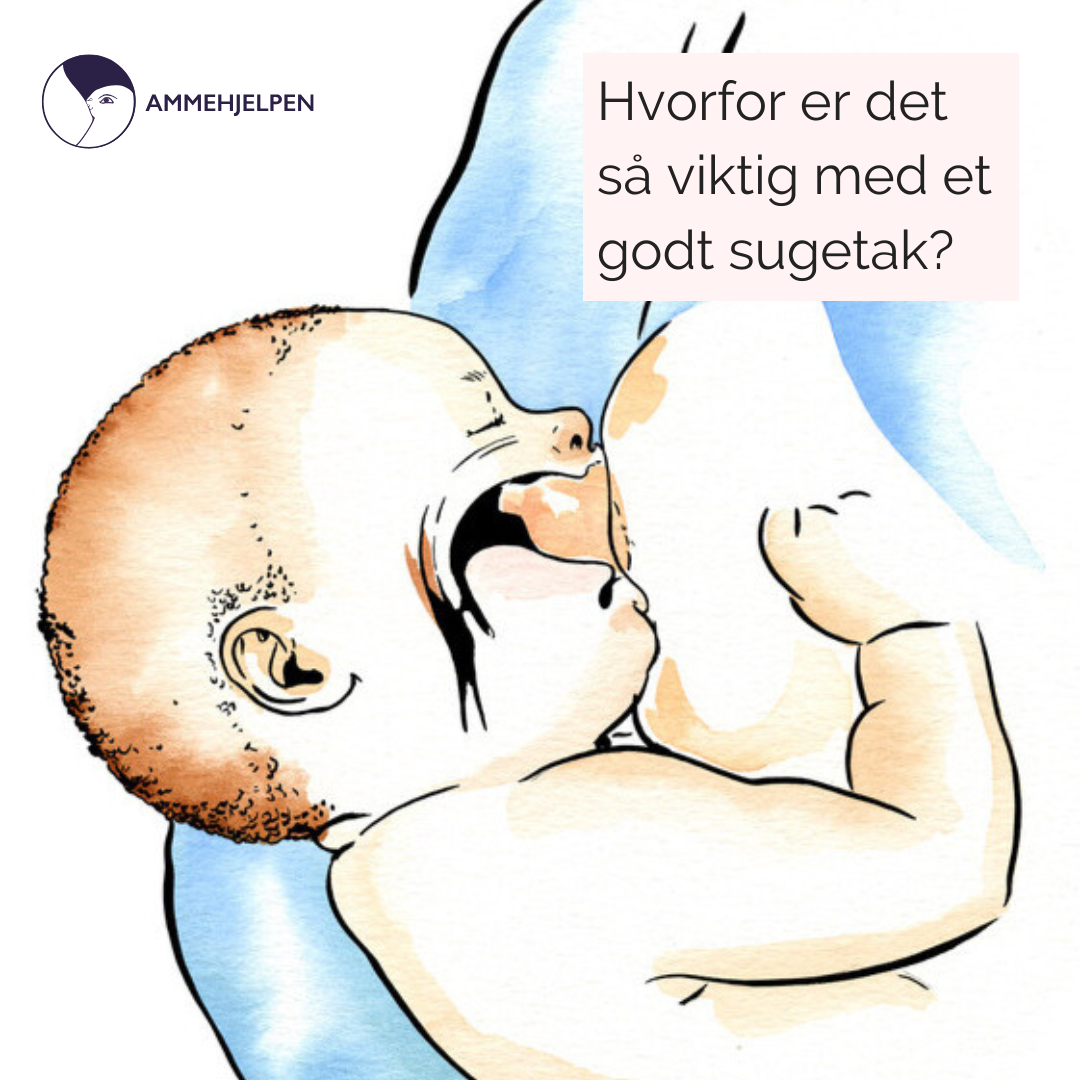
The baby has their mouth well filled with breast, not just your nipple. Baby’s chin/lower jaw is firmly planted against your breast.
When your nipple touches the baby’s palate, it elicits the reflex that makes the baby start to suckle.
When the baby is actively milking the breast with their tongue and jaw, your nipple reaches all the way to the spot where the hard and soft palate meet.
You may feel some tenderness as the baby attaches, but this should quickly pass. Ask for help if breastfeeding is painful beyond the first half minute or so of suckling. It doesn’t matter if the baby’s mouth on your breast looks all right from the outside. (If you are in pain, there is a problem.)
If breastfeeding is painful, it can be because the baby doesn’t have the breast deep enough in its mouth, and is only sucking on your nipple, pressing it against the hard palate with their tongue.
Enough milk?
Newborns normally lose a small amount of weight the first few days after birth. This doesn’t mean they aren’t getting enough milk, but that they are eliminating excess fluid from their bodies and emptying their gut of meconium.
Weight loss stops as a rule around day 2-4, as your milk supply increases. Usually the baby has come back to its birthweight by one week of age, but it may happen sooner or it may take a bit longer.
If the baby can feed whenever it likes, your body should respond by producing the milk the baby needs.
Many parents ask how they can tell whether the baby is getting enough milk from when they leave the hospital until the baby is weighed again at a home visit or at the child health center.
The answer is: look at the baby.
You can keep track of how many wet and dirty diapers the baby has each day, how often the baby is feeding, and if you can hear or observe the baby swallowing milk from day 3 or 4.
Here is an overview of what’s normal and what isn’t.(PDF)
ammehjelpen.no/ammesjekkliste (Norwegian)
Normal infant behavior, such as the baby cueing to feed often, or crying when set down somewhere alone, can be misinterpreted as signs of too little milk.
The belief that there is not enough milk is one of the most common reasons for mothers giving formula, or stopping breastfeeding before they really wanted to.
Contact your well child center if you’re concerned that your baby isn’t getting enough milk from breastfeeding.
Children grow at different rates. If the baby’s weight increases as expected according to its growth curve, s/he is getting enough milk.
Signs that the baby really isn’t getting enough milk are abnormally few wet and dirty diapers, and slow or absent weight gain.
But even if the baby is showing signs of needing more milk, it doesn’t mean that you can’t produce enough.
Through breastfeeding guidance from health care personnel, you can get help to look at factors such as:
- How often you breastfeed
- Your technique, positioning and attachment at the breast
- Delayed or absent milk ejection reflex
- Physical hindrances in the baby (such as tongue tie or musculoskeletal problems)
Breastfeeding Support: Is my baby getting enough milk?
ammehjelpen.no/lite-melk (norwegian)
Typical challenges
It’s not uncommon to experience small or bigger ‘bumps in the road’ on this journey:
- sore, painful nipples
- concerns about low milk supply
- plugged ducts or mastitis
- oversupply
- baby restless and unsettled at the breast
In addition, it’s common to worry, and wonder if what’s happening is normal when:
- the baby is unhappy when not being held
- the baby suddenly wants to feed much more often than usual
- the baby is unhappy or hard to satisfy in the evenings
- the baby cries a lot
- there is uncertainty about weight gain
- there is uncertainty about baby’s stools
- there are concerns about spitting up, burps, and reflux
The first time after having a baby can also hold other questions and challenges:
- How to handle visits, or the expectations of visits, by family and friends?
- What equipment do we actually need?
- How do we share responsibility at home?
- How can we organize housework and food as simply as possible?
- Who can answer all the questions we as first-time parents have about everything?
Why breastfeeding and breast milk?
The health effects of breastfeeding are important, both for mother and child. But our experience is that this is not necessarily the main reason most women want to breastfeed: many breastfeed because it feels natural, and because they want to.
Producing milk and breastfeeding are bodily functions following birth, and ones that most all mothers want to make use of – just as we want to make use of our bodies in other ways.
When breastfeeding is working well, it can give you a strong feeling of pride. Imagine, the baby is surviving and growing because of the milk you produce!
Breastfeeding is also more than food. It is often seen merely as a way to get milk into the baby, but breastfeeding is about so much more, too:
Breastfeeding can calm an overstimulated, upset, ill or tired child – and it can be sleep-inducing for both mother and baby.
The skin contact and the hormones that are secreted when breastfeeding is working well can give you a feeling of well-being, calm, and contact with the child which many mothers cherish.
Breast milk’s composition of fat, carbohydrates, proteins, minerals and vitamins are suited to human infants’ growth and development – in the same way that other mammals produce milk specially tailored to their own species.
Breast milk also contains components that are not found anywhere else, and are important to the child’s health in different ways:
- Antibodies and other factors that help the immune system
- Stem cells (build up tissue and organs)
- Pre- and probiotics (contribute to healthy gut flora)
- Hormones (help with sleep, diurnal rhythms and more)
- Enzymes (help with digestion)
Breast milk can lower the risk of gastrointestinal infections, respiratory infections, ear infections, overweight, sudden unexpected infant death – as well as the risk of cardiovascular disease and diabetes types 1 and 2 in later life.
Producing milk is also good for you, lowering your risk of, among other things, breast cancer and cardiovascular disease.
Many of the health effects are stronger the more breast milk the baby gets, and the longer you breastfeed.
Not everyone can, or chooses to, exclusively breastfeed (give the baby only breast milk). Partial breastfeeding combined with formula can be a good alternative in these cases. It needn’t be just the one or the other. Partial breastfeeding has health effects for both you and the baby, and gives you the chance to experience breastfeeding together.
- ammehjelpen.no/morsmelk-vs-mme
- ammehjelpen.no/morsmelk
- ammehjelpen.no/kvinnehelse
- ammehjelpen.no/delamming
Emotions in the first weeks?
The first weeks after having a baby can be magical. They can also be the toughest and most intense you have ever experienced.
Some feel that the fantastic things about having a baby outweigh the exhausting and unaccustomed parts. For others, it’s the opposite.
Many feel vulnerable and tired, both physically and mentally.
You haven’t merely given birth to a baby. You have also been born as a mother. Your brain is flooded with hormones, in almost the same way as during puberty.
You are responsible for keeping a small human alive – and have to adjust to your new life at the same time. You may feel lost, your emotions are a roller coaster, tears come easily and you wonder who you are now.
It’s easier if we talk to others about it. All mothers are in this state to greater or lesser degree, briefly or for a longer time. You are not alone.
NB. Ask for help from your midwife, health visitor or doctor if the situation feels extremely upsetting, or if you are having difficulty adjusting to this new life. This holds for partners as well. There is help available!
Stop breastfeeding?
Many mothers are surprised over how important it can feel to succeed at breastfeeding, and how disappointing it can be when things don’t og the way you imagined.
It’s common to feel sadness, anger, shame, resentment, and/or frustration.
Ask for help if you run into problems breastfeeding. It’s not your responsibility to manage everything about breastfeeding on your own.
Ask for help from health personnel with extra training in breastfeeding guidance when you need it, whether you want to exclusively breastfeed, partially breastfeed – or stop breastfeeding altogether.
There are many reasons it can be both necessary and right to use infant formula.
But formula milk should never be a substitute for breastfeeding guidance if what you want is to breastfeed.
If breastfeeding isn’t right, or possible, for you, you don’t have to justify it to anyone. You have a right to whatever help, support and information you need, no matter how your child is fed.
Luckily, being a good mother isn’t defined by whether your baby’s milk comes from a breast or a bottle.
Bottle feeding
Bottle feeding at a leisurely and sensitive pace lets the baby take natural breaks. It allows the baby to end the feeding when he feels full enough. The baby should determine how much milk goes in, in the same way as during breastfeeding.
Eye contact and closeness come automatically while breastfeeding, but you can create the same conditions when bottle feeding.
The idea is that there should be as little difference as possible between breastfeeding and bottle feeding. This goes for all babies who are bottle fed, whether it’s just occasionally or if the baby is fully bottle fed.
There is no bottle that’s better than all the others, even if the manufacturers claim otherwise. What matters most is how the bottles are given, and that the opening in the nipple isn’t too big.
Sleep
New parents are often surprised to find that the job isn’t done when the day is over. Newborns don’t have an established sleep pattern, and their needs for closeness, security and milk are the same around the clock.
Practically all babies and young children wake during the night, for many different reasons. It’s only natural that infants want to be with the people who love and care for them, especially when they are ready for sleep.
Sleep is important. Still, it’s both common and normal that we sleep less, and with more interruptions, during our childrens’ early years than we did before they were born.
So how can we get as much sleep as possible?
A safe sleep environment
It’s vital for a baby to have a safe place to sleep, and all parents need to be informed of what the current recommendations are, to ensure this.
The Norwegian SIDS and Stillbirth Society works to prevent infant death and accidents that can occur during sleep. See their website, https://lub.no/english/ for more information.
Can my baby sleep in a ‘nest’ or a hammock at night? When can my baby sleep alone, in their own room? Can a baby share a bed with an adult who uses snuff? What kind of mattress should the bed have? Duvet or sleeping sac?
(You’ll find links to both the SIDS and Stillbirth Society and international organizations working in this area in an article on our website about how to ensure the safest possible sleep environment for your baby:
ammehjelpen.no/trygg-babysoevn
Bedsharing
Bedsharing (sleeping in the same bed as your baby) is both normal, and very widespread.
All new parents need to know what safe bedsharing is – and what it isn’t – whether they intend to bedshare or not. This is because nearly all babies share a bed with their parents at some point, planned or not. Parents of young children are tired, breastfeeding is sleep-inducing, and most infants are best settled if they can sleep near their parents.
Bedsharing may be the option that gives the most sleep to the most family members: it makes it easier to breastfeed at night, and it means you don’t need to get out of bed to feed the baby, thereby waking up more than necessary. Breastfeeding in reclining positions is practical and relaxing at night, and can be well worth the effort to learn how.
If, for example, you think there’s a chance you might fall asleep, at any time of day or night, while holding the baby or breastfeeding it, it’s considered much safer to lie down in bed and make sure the conditions for safe bedsharing are met, than to sit on a chair or couch and risk falling asleep there.
Learn about the recommendations for safe bedsharing at lub.no and here:
Is it true that…?
There is an abundance of myths and misunderstandings around breastfeeding and infant care. How many of these have you heard?
- You mustn’t eat (…) because the baby will get a tummyache
- The bubbles from fizzy drinks pass into your milk
- Nipples need toughening to breastfeed
- You can get mastitis if you get a chill
- Carbonated water can be used to treat infant thrush
- There is nothing to do about colic
- Crying strengthens the baby’s lungs
- Your breastmilk can be lacking in nutritional value
- Breastmilk loses its nutritonal value after (…) months
- Formula milk always improves the baby’s sleep
- It makes no difference whether the baby gets breastmilk or formula
- Breastfeeding ruins your breasts
- You mustn’t let the baby use your breast as a pacifier
- Breastfeeding a baby to sleep is a bad habit
- Babies over 6 months old don’t need to be breastfed at night
None of these things are true.
Do you live in Norway and need help with breastfeeding?
If you need more help than what you can find on our website, you can contact our volunteer breastfeeding peer supporters (‘ammehjelper’) by phone, e-mail or on social media. Most of them speak English as well as Norwegian, and some speak additional languages.
We’re here to help you if you want to breastfeed, if you breastfeed a lot, or a little, and if you want to stop breastfeeding.
We also answer queries from fathers, co-mothers, grandparents, and others.
Want to join us?
It’s incredibly rewarding to get to help another mother in a vulnerable phase in life!
To become a volunteer breastfeeding peer supporter in Ammehjelpen, you must have personal breastfeeding experience, have read our required literature, and successfully completed our written test. You must also be able to read and understand Norwegian.
Var artikkelen nyttig?
Oppdatert 29.03.26